From Practitioner to Educator | “Same Passion but Different Roles”
Birthdays are often a time where one looks back at the journey that has been. As eCALD turns 21 years, it feels a bit unreal to think I have been with the service full time for almost three years helping to carry on the founding goal of enhancing health equity for CALD communities.
My entire career has been shaped by my passion for social justice, equity, and wellbeing. Prior to eCALD, I had worked in specialist mental health services and was working in the family harm sector when I was asked in early 2023 to contract for eCALD. It was not very long after I discovered my interest in facilitating growth in others in their academic and professional pursuits. When the opportunity came about to be part of the eCALD team full time, I did not hesitate at all as eCALD has been at the forefront of training health practitioners to better work with the CALD population since eCALD’s inception in 2005.
New Zealand became increasingly culturally diverse from mid-to-late 1990s onwards. From around 8% of the population accounted in the 2006 Census, CALD population is now estimated to be close to 25%. To be more responsive to the needs of the changing demographics, eCALD is currently in the process of reshaping our modules, starting with the 4 foundation modules. These modules, in particular the refugee and migrant focused modules, are being re-designed by incorporating the voices of community members and health practitioners.
Work on creating the now titled ‘CALD Matters: Refugee Communities’ commenced in 2024. The voices and experiences of refugee background community members were gathered through five community engagement workshops. Refugee sector practitioners were also interviewed. Work on ‘CALD Matters: Migrant Communities’ commenced at the end of 2025. After collating and analysing data from 10 workshops and 14 one-on-one interviews held over 4 months this year, we are currently in the process of creating the redesigned module.
While it is a significant amount of work, it was a privilege to meet and engage with incredible people from diverse backgrounds living in various parts of the country and as someone who has personal and professional experience working with individuals and communities on the ground, I absolutely cherished the opportunity to fieldwork. It was an honour to have been trusted with their stories with the belief that doing so will help enhance equity in healthcare delivery and access. Doing the fieldwork reminded me why we do what we do at eCALD and that there is a lot more work to do collaboratively and collectively at all levels if we are to achieve health equity in New Zealand for all.
During my time at eCALD, I have also been incredibly honoured to meet some amazing practitioners from across the nation working tirelessly to make a difference for the communities they serve and are committed to upskilling to become culturally responsive to the rapidly diversifying population. Facilitating education sessions across the nation with practitioners from diverse professional and personal backgrounds over the last few years have certainly enhanced my own knowledge and practice.
While being an educator is not something a younger Dulani would have envisaged, I am utterly delighted I did make a slight sideways career change. While it may not be everyone’s joy, I also happen to enjoy academic research and writing which I believe are essential to developing the new refreshed modules and scripting interesting and informative eNews articles. All the diverse dimensions of my role certainly do not make it a dull day at work, but rather a treasure cove for critical reflection to grow oneself. While my role is to facilitate training in cultural responsiveness, I am unable to do this effectively if I am not to work on my own cultural responsiveness and my ability to respond to diverse needs.
Dulani Abeysinghe, eCALD Educator
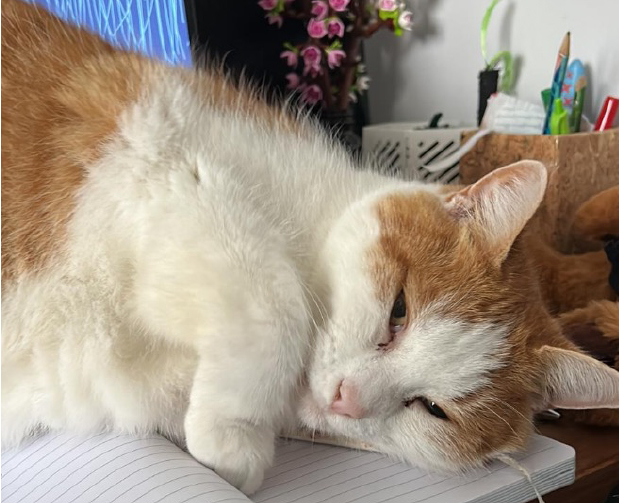
Picture: Frank, Dulani’s most supportive learner.