From Cultural Competency to Cultural Responsiveness | Advocacy for Equitable Healthcare and the Evolution of eCALD Services
Aotearoa New Zealand is widely recognised as a global leader in advancing health equity through culturally responsive and Indigenous-centred approaches to healthcare. But how did we get here? And how has eCALD Services evolved from its early beginnings to become a trusted provider of cultural responsiveness education for the health workforce? This article explores the journey of advocacy, leadership, and innovation that shaped both.
Advocacy for equitable healthcare has evolved significantly over time. The foundations of health equity can be traced to public health reforms in Europe and North America during the nineteenth and twentieth centuries, as well as human rights movements that gained momentum following World War II. These developments contributed to the recognition of health as a fundamental human right. The World Health Organization (WHO), established in 1948, laid an important foundation for health equity advocacy through its declaration that “the enjoyment of the highest attainable standard of health is one of the fundamental rights of every human being.”
A major milestone in the global health equity movement was the Alma-Ata Declaration of 1978, which promoted primary health care, community participation, and the goal of “Health for All.” This declaration is widely regarded as the starting point of the modern global health equity movement. Today, Aotearoa New Zealand, Canada, and Australia are frequently recognised as international leaders in advancing health equity through culturally responsive and Indigenous-centred approaches to healthcare.
In Aotearoa New Zealand, advocacy for health equity was significantly influenced by Dr Irihapeti Ramsden, a Māori nurse, educator, and researcher. Throughout her nursing career, Ramsden observed and challenged the inequities experienced by Māori within the healthcare system. During the 1980s, she developed the concept of Cultural Safety (Kawa Whakaruruhau), a framework that encourages healthcare professionals to examine the impact of colonisation, power imbalances, and cultural differences on healthcare experiences and outcomes. This period marked the beginning of widespread public advocacy for Māori health equity and led to the incorporation of Cultural Safety into New Zealand nursing education in 1992.
The influence of this movement extended beyond education and into healthcare regulation. The Health Practitioners Competence Assurance Act 2003 established a framework that enables professional regulatory authorities to set competency standards for health practitioners, including standards related to cultural safety and cultural competence. These standards support equitable healthcare outcomes for Māori and other populations across Aotearoa New Zealand.
The founder of eCALD Services, the late Sue Lim, recognised similar gaps in equitable healthcare for migrants, refugees, and culturally and linguistically diverse (CALD) communities. In the early 2000s, she began developing face-to-face educational programmes to enhance healthcare practitioners' ability to work effectively with CALD populations. Her commitment to promoting cultural competency among health professionals gained momentum and became recognised both nationally and internationally.
Today, eCALD Services has grown into a substantial learning community, recently welcoming its 50,000th registered user. The service now offers 17 courses delivered through a range of formats, including face-to-face training, remote learning via videoconferencing, and eLearning.
Over the years, both the demographics of healthcare consumers and the healthcare workforce have changed significantly. At the same time, understandings of health equity from a cultural perspective have continued to evolve. Through engagement with healthcare practitioners, community stakeholders, and learner feedback, the eCALD team has recognised that the field has progressed beyond cultural competency alone. We believe the time has come to shift our educational focus toward culturally responsive care.
Some may wonder why eCALD Services is moving from a cultural competency approach to a culturally responsive care approach. While the two concepts are closely related, there are important differences.
Cultural competency focuses on developing the knowledge, skills, attitudes, and behaviours required to work effectively with people from diverse cultural backgrounds. Learning is often achieved through formal education and training programmes.
Culturally responsive care, however, extends beyond the acquisition of knowledge and skills. It emphasises ongoing reflection, responsiveness, and partnership. Healthcare professionals are encouraged to continually learn from consumers, families, communities, colleagues, and lived experiences. Culturally responsive care recognises each person's unique circumstances and supports collaborative practice that addresses differences, power dynamics, and inequities at individual, organisational, and system levels.
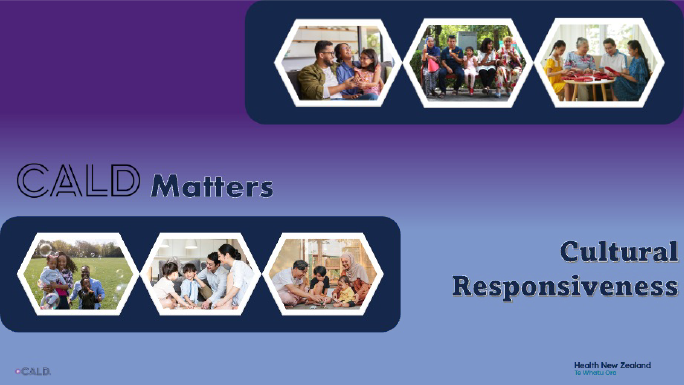
In response to this evolution in cross-cultural healthcare practice, the eCALD team has begun developing a new suite of foundational courses to replace the current programme. We are grateful to the many contributors who have generously shared their time, expertise, and feedback through recent testing sessions. Their contributions have helped shape our new courses, CALD Matters: Cultural Diversity and CALD Matters: Refugee Communities. These courses are expected to be launched alongside CALD Matters: Migrant Communities and CALD Matters: Effective Partnership with Interpreters in early 2027.
The success of eCALD Services belongs to the healthcare workforce and the CALD communities of Aotearoa New Zealand. Together, we have advanced equitable healthcare for diverse populations, and together we will continue building a healthcare system that is increasingly inclusive, culturally responsive, and equitable for all.
Choi Foong Kew, eCALD Manager, Health New Zealand | Te Whatu Ora