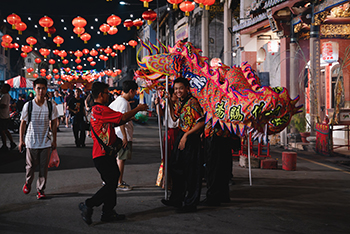
Chinese New Year | The Malaysian Chinese Way
Chinese New Year is widely celebrated across Southeast Asia. Although Malaysia’s population is predominantly Malay, Chinese New Year is recognised as a public holiday. Let’s read about how a Malaysian Chinese migrant observes this festival in a country where CNY is not a public holiday.
Celebrated by over 20% of the world population, Lunar New Year or the Spring Festival, falls on the 17th of February this year. It marks the start of a new year on the lunisolar calendar and the beginning of spring. Although widely known as the Chinese New Year (CNY) Festival, it is also the traditional new year in Vietnam and the Korean Peninsula.
Acknowledged as a UNESCO Intangible Cultural Heritage of Humanity in 2024, CNY is regarded as being important in providing a sense of identity and pride in their cultural heritage, not only for those living in China but also for overseas Chinese communities. The weakening of The Qing Dynasty, The Opium Wars, and widespread poverty and famine in the mid to late 1800s resulted in one of the largest waves of migration from the southern parts of China. While smaller numbers made it to all corners of the earth including New Zealand, the majority re-settled themselves in Southeast Asia and in particular, Thailand and Malaysia.
The Malaysian Chinese have firmly established themselves through significant contributions economically, societally, and culturally as the second largest ethnic group in Malaysia (after the Malays) while maintaining the traditional practices of their Chinese origins. CNY, a public holiday in Malaysia, is thus a very important time of the year. Families take part in rituals and customs passed down from their ancestors but adapted over generations resulting in some distinctive Malaysian Chinese celebratory traditions. Ai Cheng, a practicing community pharmacist for over 14 years who arrived in New Zealand at the age of 12, says the ‘Malaysian Chinese way of celebrating CNY is an amalgamation of traditions from different regions of China that the ancestors originated from’.
Ai recalls it was a culture shock to come from a country where CNY was widely recognised, anticipated, and celebrated to New Zealand at a time when CNY was hardly acknowledged. There were no CNY community festivals and events, or any CNY activities in the libraries like those seen today. She said while the family could not celebrate CNY like they did in Malaysia; her mother kept the tradition of reunion dinner despite not having extended family here. Considered the most important meal of the festivities, reunion dinner takes place on CNY eve. Traditionally it is a time to celebrate family unity over scrumptious dishes that symbolises longevity, abundance, and prosperity.
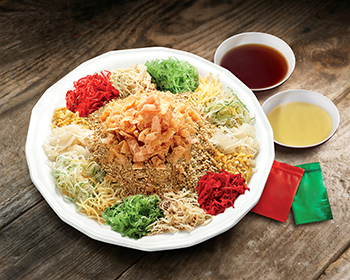 The dishes at a reunion dinner vary depending on the family origins, and ancestral ties. One dish that is a common feature in both Malaysian and Singaporean CNY celebrations is yusheng/lo shang/lo hei or ‘prosperity toss salad’. Said to have derived from the Cantonese population that settled in those parts, each salad ingredient has symbolic significance. The colourful salad is tossed in the air with chopsticks by all at the table while saying auspicious wishes. Some believe that the higher you toss the salad, the greater success and prosperity you will attract in the year ahead. While there is no difficulty finding traditional ingredients now in New Zealand, Ai acknowledges that her mother used to think of substitutes for a lot of the items as they were not so readily available here 20 years ago. This speaks to the ability to adapt to new geographical locations while still maintaining the essence of cultural traditions.
Ai has now taken on the role of making the yusheng and hosting the reunion dinner with family and close friends. As a mother of two New Zealand-born young children, she sees engaging in CNY traditions as a meaningful way to ensure the next generation stays in touch with their cultural roots, honour their ancestors, and accepts all aspects of their cultural identity.
Dulani Abeysinghe, eCALD® Educator, Health New Zealand | Te Whatu Ora